The Workbench
Domantas Sabonis Rookie Cards: What Collectors Should Know
How to identify and compare Domantas Sabonis’s 2016–17 base rookies, numbered parallels, autographs, memorabilia cards, and one-of-ones.
Domantas Sabonis’s rookie-card year is 2016–17. That gives collectors a useful starting point, but it does not make every card from that season equal. A base rookie, a numbered parallel, an autograph, a patch autograph, and a one-of-one can share the same player and rookie year while occupying very different parts of the checklist.
The right way to compare them is to identify the exact card first. Set, card number, parallel, serial numbering, autograph or memorabilia content, condition, and eye appeal all matter. “Sabonis rookie” is a category. It is not a complete identity.
Start with the 2016–17 rookie year
The 2016–17 designation anchors the search. From there, confirm the manufacturer and set, then find the card number and the checklist entry. Base sets, autograph subsets, memorabilia subsets, and high-end releases can all produce rookie-year cards with different designs and print runs.
Do not rely on a marketplace title alone. Sellers can omit a parallel name, shorten a subset, or call any early card a rookie. Compare the card itself with a dependable checklist and make sure the year and product line match.
Base rookies
A base rookie is the standard rookie card in a set’s main checklist. It is often the most accessible version and can be a clean way to collect the player without paying for serial numbering, an autograph, or memorabilia.
“Base” does not mean unimportant. Set reputation, design, condition, and collector recognition can still matter. It simply tells you that the card is the regular version rather than a named parallel or separate autograph or memorabilia issue.
Numbered parallels
A numbered parallel changes the base or subset card through color, finish, pattern, or another defined variation and carries a stated serial-numbered print run. The parallel name and the serial stamp belong in the card’s identity.
A card numbered to 99 is not interchangeable with one numbered to 25, and neither is interchangeable with an unnumbered card that merely uses a similar color. Verify the stamp and the official parallel name. Also check whether the serial number is printed on the front or back so a listing does not hide the evidence needed to identify it.
Lower numbering establishes lower stated production for that exact parallel. It does not, by itself, establish condition, eye appeal, demand, or a market price.
Autographs
An autograph rookie adds a player signature to the card’s identity. Some autograph cards are parallels of an autograph subset; others are distinct rookie-autograph designs. The checklist should tell you which one you are looking at.
Collectors should verify whether the autograph is on-card or on a label, whether the card is serial numbered, and whether the signature or label shows visible issues. Those details describe the card. They should not be turned into a blanket claim that one format is always better.
Patch autographs and memorabilia cards
A patch autograph combines a signature with an embedded piece of material. A memorabilia rookie can contain material without an autograph. The card’s wording and checklist determine what the material is represented to be; the appearance of the swatch alone does not prove its source.
Large or multicolor patches can add eye appeal, but the full card still matters. Edges around thick cards, surface wear, corner condition, autograph quality, serial numbering, and the strength of the design all contribute to how collectors compare examples.
One-of-ones
A one-of-one is serial numbered 1/1 for that exact checklist entry or parallel. It is the only copy of that defined version, not the only Domantas Sabonis rookie card and not automatically the most desired Sabonis card for every collector.
One-of-one status makes exact identification especially important. A printing plate, a named parallel, and a one-of-one autograph can all carry 1/1 numbering while being materially different cards. The set, subset, parallel, autograph status, and card construction explain what the “one” actually is.
What drives collector interest
Several factors work together:
- Set demand: Some product lines have stronger collector followings than others.
- Scarcity: Serial numbering and checklist structure define how many copies of that exact version were produced.
- Condition: Corners, edges, surface, centering, print quality, autograph presentation, and memorabilia windows can all matter.
- Eye appeal: Color match, design balance, photograph, patch appearance, and the way the autograph sits on the card affect how an individual copy presents.
- Collector demand: Demand for the player, set, card type, and specific parallel can differ. Scarcity alone does not create demand.
These factors are reasons to inspect the exact card, not shortcuts to a guaranteed value. Asking prices, completed sales, grading populations, and private valuations are separate evidence and should be handled separately.
Hammy’s Sabonis 1/1
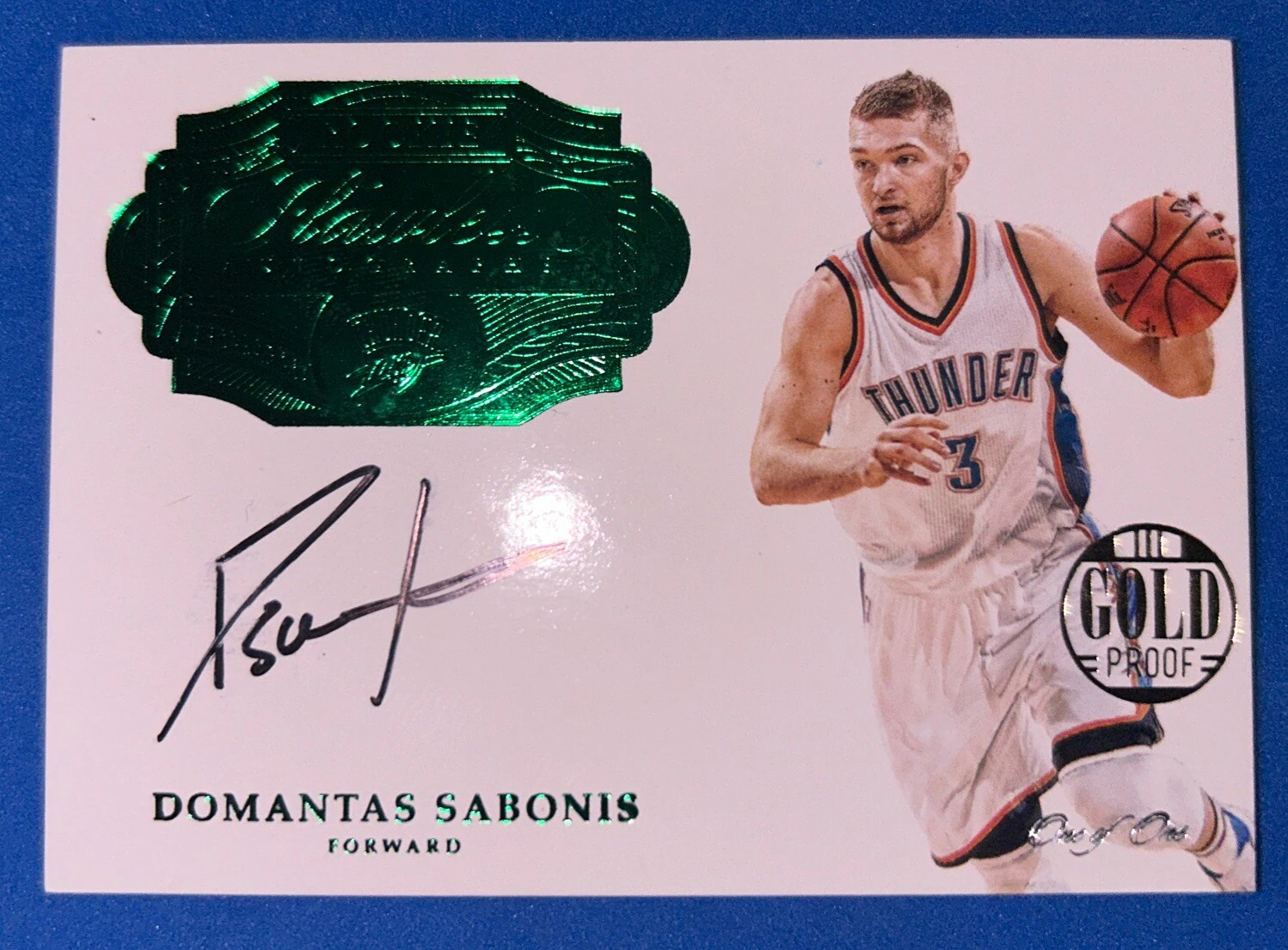
Hammy owns the 2016–17 Panini Flawless Domantas Sabonis Rookie Auto Emerald Gold Proof 1/1. The inventory record identifies it as a raw card with the parallel recorded as Emerald Gold Proof Rookie Autograph and the serial number recorded as 1/1.
That full name matters. “Sabonis rookie” leaves out the set, autograph, named parallel, and 1/1 numbering. Those details separate this card from a base rookie or another autograph.
The photograph at the top of this guide shows that card. The inventory record lists card number 9. The card is not currently available.
A practical comparison checklist
When comparing a Sabonis rookie listing, write down:
- the 2016–17 product name and manufacturer;
- the set or subset;
- the card number;
- the complete parallel or variation name;
- the serial number, if any;
- whether it is signed and how the autograph is presented;
- whether it contains memorabilia and how the card describes it;
- whether the photos show the card being offered and enough detail to judge it;
- visible condition details and any grading information;
- the evidence supporting any price comparison.
That list prevents a common mistake: comparing cards that share a player and rookie year but are not actually the same item.
What not to assume
Do not assume a one-of-one has no condition concerns. Do not assume an autograph is rarer than every unsigned parallel. Do not assume an expensive set guarantees stronger demand. Do not treat an asking price as a completed sale, and do not treat a population count as a complete census of every ungraded copy.
Most importantly, do not let a broad search result replace a full card identity. The more unusual the card, the more carefully the checklist, serial number, photos, and condition should line up.
Bottom line
Sabonis’s 2016–17 rookie cards range from base cards to numbered parallels, autographs, memorabilia cards, and one-of-ones. Name the set, card type, parallel, and numbering before comparing prices. Scarcity, condition, eye appeal, and collector demand all matter.